



New Research Infrastructure at the Faculty of Physics: A Cleanroom for the Development of Advanced Detectors
19 01 2026
Category: Astronomy, IDUB research infrastructure, Physics
A new high-specification research facility – a cleanroom – has been established at the Faculty of Physics, University of Warsaw. The facility enables experiments involving advanced materials, nanotechnology and precision electronics. Thanks to state-of-the-art air filtration systems and strict safety procedures, the laboratory ensures the highest level of cleanliness, which is essential for obtaining reliable experimental results. The investment was implemented under the IDUB programme.
The project was led by Professor Wojciech Dominik from the Faculty of Physics, who oversaw the acquisition of the cleanroom chambers. The project received funding of 305,000 zlotys under IDUB Action I.4.2 “Fund for the Renovation and Development of Research Infrastructure”, implemented within Priority Research Area II: “Beyond Micro and Macro Worlds”.
Cleanrooms play a crucial role in scientific research, where the elimination of contaminants that could affect experimental outcomes is essential. This technology is particularly important in fields related to semiconductors, nanomaterials and optoelectronics. Maintaining high cleanliness standards makes it possible to construct and test innovative devices such as precision sensors, electronic systems and optical photonic components.
Precision without compromise
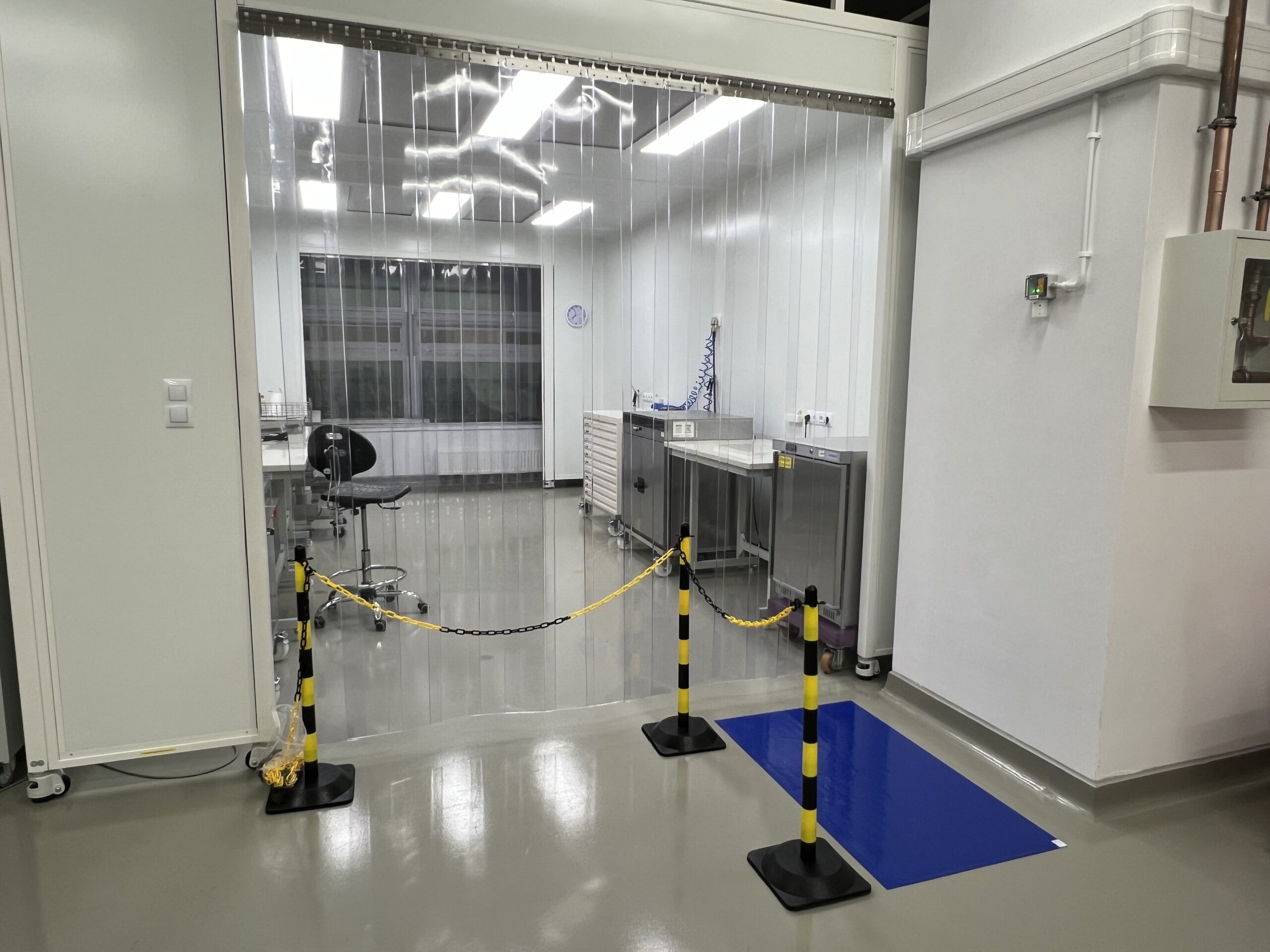
The new laboratory, located in the CENT-II building at the Faculty of Physics, consists of two zones:
- An open-space assembly zone of 120 m², equipped with configurable assembly workstations, a layout table, single-phase and three-phase power supply, compressed air installations and dry nitrogen supply.
- A mobile cleanroom tent with an area of 24 m² (6 × 4 × 3 m), operating under positive pressure, generated by laminar airflow units with HEPA filters; the cleanliness level corresponds to ISO Class 8.
The cleanroom’s mobile design allows it to be moved over already assembled apparatus components up to 2 metres in width and height. This enables precise assembly stages to be carried out without the need to relocate large devices, significantly reducing the risk of damage and contamination.
An existing garage gate in the high-bay laboratory, together with a dedicated transport door in the separating wall, also allows large objects to be transported directly from street level.
Key benefits
The project will permanently enhance the scientific potential and technical capabilities of the University of Warsaw. It will enable preparatory research essential for submitting new grant applications and for establishing new collaborations in the field of advanced medium-scale instrumentation for particle physics, astrophysics and nuclear physics.
Upon completion of the project, the following research and development activities will be possible:
- assembly of gas detectors for ionising radiation with micro-pattern amplification structures and active areas of approximately 1 m²;
- assembly of Time Projection Chamber (TPC) detectors with electron drift cage structures up to 1 metre in length;
- assembly of arrays of semiconductor detectors, silicon photomultipliers or CCD systems;
- assembly of low-pressure or high-pressure TPC chambers with auxiliary detectors;
- construction of advanced vacuum and gas-mixing installations for medium-scale TPC chambers.
The facility may also be used for maintenance of high-vacuum-generating equipment and vacuum monitoring systems.
In the coming years, further expansion of the infrastructure is planned, including the addition of a precision soldering station with fume extraction, a larger ultrasonic bath cleaner, and connection to the deionised water installation in the CENT-II building.
Access to the facility
The new infrastructure is available to research teams from the Faculty of Physics as well as other units within the University of Warsaw. Access is coordinated by the Division of Particles and Fundamental Interactions, which manages bookings for the free use of the cleanroom within research projects. Priority in booking is given to groups conducting experiments in nuclear and high-energy physics.
Researchers interested in accessing the cleanroom and its equipment are invited to contact Professor Wojciech Dominik (Wojtek.Dominik@fuw.edu.pl), who oversees the facility and can provide detailed information on its use.
A detailed technical description of the infrastructure is available here.